After the Peel: A Field Guide to the Takeaway Pizza's Short, Steamy Life
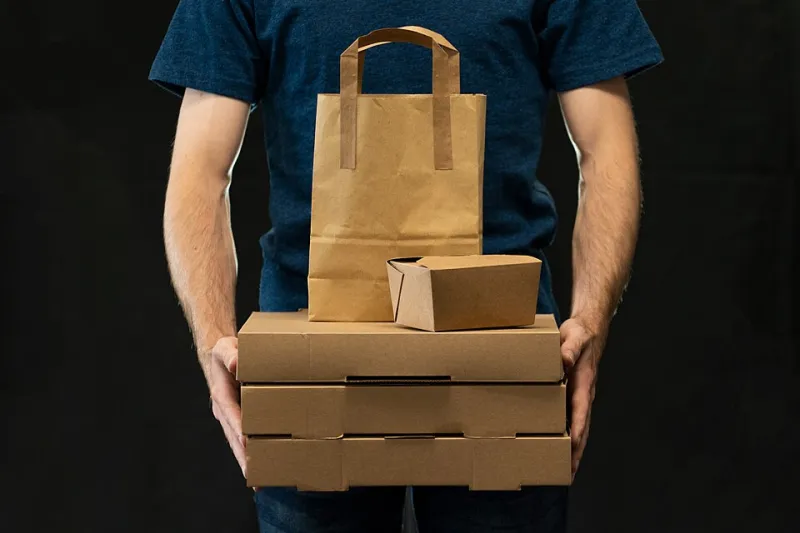
Photo: Meanwell Packaging, CC BY 2.0, via Wikimedia Commons
Ask anyone who has carried a pizza box home on a bus and they will tell you the truth: the oven is only half the story. The other half is the journey. At Pizza 45, we spend a lot of time thinking about dough, heat and fermentation, but the bit between the peel and the plate deserves its own field guide. A takeaway pizza is not a static thing. It is a small, steamy ecosystem in a cardboard box, and it starts changing the moment it leaves the stone.
The clock starts before the lid closes
The first thing to understand is that a pizza does not begin to cool evenly. The base is dense and hot, the cheese is molten, and the toppings are still releasing moisture. As soon as the pie is boxed, that moisture has nowhere to go. It rises, hits the cardboard lid, condenses, and then — unhelpfully — falls back onto the surface. This is why a pizza that was crisp on the peel can feel soft by the time you open the box. It is not a myth, and it is not your imagination. It is steam doing what steam does.
A good takeaway will use a box with vents, or at least avoid sealing the lid too tightly. Some will rest the pizza on a wire rack for a few seconds before boxing, letting the first burst of steam escape. Those small moves matter. In 2026, with more UK kitchens doing collection-only or short-radius delivery, the box itself has become part of the craft.
Minute zero to ten: the golden window
If you are eating within ten minutes of the oven, you are in the best possible place. The base should still have an audible crunch at the cornicione, the cheese should be set but not rubbery, and the toppings should taste of themselves rather than of the box. This is the window where a good pizza needs nothing done to it. No reheat, no blotting, no rescue mission. Just eat.
The ten-minute mark is also where the first real compromise appears. The centre of the base starts to soften as steam works its way down. A thin, high-hydration dough will show this sooner than a sturdy one. That is not a flaw in the dough; it is physics. If you are collecting, this is the window to aim for. If you are ordering delivery, it is the window to ask about.
Ten to twenty minutes: the first compromises
By fifteen minutes, the cheese has usually lost its glossy pull. It may still be hot, but it has begun to set into a single layer. Some people prefer this — it is neater, easier to slice, less likely to slide off — but it is a different pizza. The crust at the edge will still have some snap, while the centre will feel softer underfoot. Toppings with a high water content, such as mushrooms, courgette or pineapple, will have started to release liquid into the cheese.
This is also when the box becomes a factor. A stacked box, a tilted box, or a box left on a cold passenger seat will all speed up the decline. If you are driving home, keep the box flat and away from the car heater. If you are on a bus, resist the urge to rest it on your knees. The base is still hot enough to keep cooking, and that residual heat is both a gift and a threat.
Twenty to thirty minutes: the rescue zone
At twenty minutes, most takeaway pizzas are still perfectly edible, but they need a little help. The base has lost its initial crispness, the cheese has set, and the toppings have begun to merge into one another. This is the point where a domestic oven, a frying pan or an air fryer can bring a slice back to life. A two-minute blast at high heat will re-crisp the base and re-melt the cheese without drying out the cornicione. A dry frying pan works well for a single slice: press it down gently and let the base toast.
Do not microwave a pizza unless you have given up on joy. The microwave heats water, and water is the enemy here. It will make the base limp and the cheese rubbery in a way that no amount of chilli oil can fix.
Thirty to forty-five minutes: the benchmarks
Thirty minutes is where the average British delivery pizza starts to feel like a different meal. The crust is soft, the cheese is set, and the toppings are warm rather than hot. It is still food, and good food at that, but it is no longer the pizza the kitchen sent out. At forty-five minutes, you are in reheating territory. A slice can still be worth eating, but it needs a hot pan or a hot oven, and it will never quite recover the texture it had at minute five.
Our simple benchmark: if the box arrives within twenty minutes, eat it immediately. If it arrives between twenty and thirty, give it a quick blast. If it arrives after thirty-five, reheat it properly and adjust your expectations. If it arrives after forty-five, consider it a lesson in geography.
What UK delivery does differently
British takeaway pizza has its own set of obstacles. Flats with buzzers, terraced streets with no parking, e-bike riders balancing a box on one arm, and the great British weather all add time. A pizza that travels two miles in a city can take longer than one that travels ten miles down a dual carriageway. The box does not know the difference. It only knows time, heat and moisture.
This is why collection is often the better bet for a serious slice. You control the clock. You can smell the pizza before it is boxed, pay, and walk out with it still breathing. It is not always practical, but when it is, it is the closest thing to eating at the counter.
A final slice of advice
The 45-minute window is not a hard rule; it is a reality check. A great pizza can survive a short journey, and a mediocre one can be ruined in five minutes. The best thing you can do is shorten the gap between oven and mouth, keep the box flat, and reheat with intention. After that, the pizza will do what it does. Your job is to be ready.