Don’t Join the Queue Blind: A Pizza Van Field Test for UK Market Days
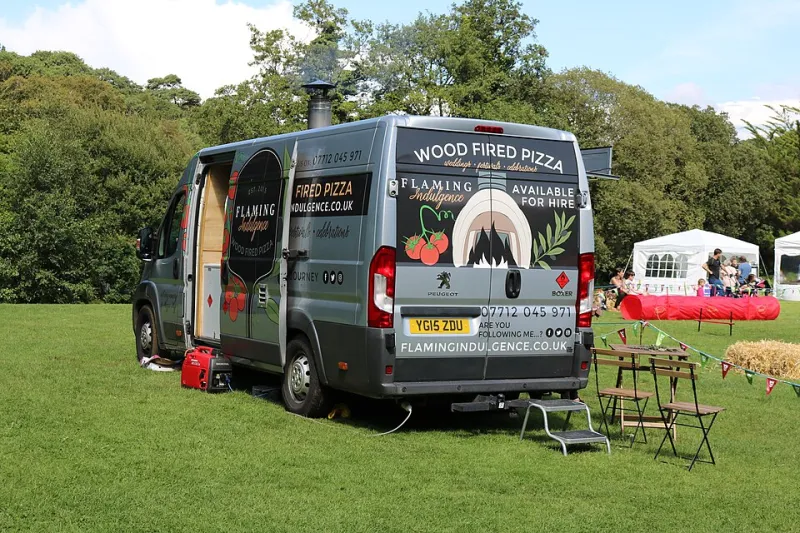
Photo: Billy McCrorie , CC BY-SA 2.0, via Wikimedia Commons
Saturday morning, farmers’ market, the smell of woodsmoke and the sight of a queue curling past a chalkboard. It is one of the great British food moments. It is also one of the easiest places to spend £12 on a lukewarm base and a handful of tired mozzarella.
Pizza vans are not automatically worse than restaurants. Some of the best slices in the UK come out of a trailer with a two-person team and a queue that never seems to end. But street food has its own tells. You can learn a lot before you reach the front by watching the dough, the oven and the rhythm of service. Here are twelve questions to ask yourself before you commit.
First, watch the dough
1. Are bases being stretched to order? If you can see someone opening dough as orders come in, good. If you see a stack of pre-stretched discs sitting on a tray under oil, walk on. Pre-stretched bases dry at the edge, lose their spring and usually bake into something cracker-like rather than pillowy.
2. Is the dough at room temperature? Cold dough tears, resists stretching and bakes pale. On a chilly market morning, a good van will have its dough out and coming up to temperature, not pulled straight from a fridge and fought with.
3. Can you see any sign of fermentation? You do not need a full sourdough sermon. But dough that looks alive, with a gentle domed top and a few bubbles, is a better sign than a flat, grey block. Ask how long it has had. A straightforward “mixed last night” is fine. A vague shrug is not.
4. Is anyone using a rolling pin? This is not a snobbery thing. A rolling pin pushes gas out of the dough and compresses the rim. If you see one being used on a pizza base, expect a flat, biscuity result rather than oven spring.
Then check the oven and the queue
5. What kind of oven is it? A wood-fired trailer, a gas deck oven, a portable stone oven: all can make good pizza. The question is whether the oven is being run properly. A wood oven that is roaring is promising. A gas oven with a stone that looks tired and pale is less so. You are looking for heat that can recover between pizzas, not just a nice orange flame for the Instagram reel.
6. Does the queue move in a rhythm? Watch for five minutes. A good van sends pizzas out in a steady flow. If the queue is long but nobody has received anything for ten minutes, the oven is probably overloaded or the dough is being stretched too slowly. A queue is not a guarantee of quality. Sometimes it is just a guarantee of poor planning.
7. Is there a holding shelf? If cooked bases are sitting under a lamp waiting for toppings, or par-baked discs are stacked up, be cautious. Pizza is at its best in the first minute or two out of the oven. A holding shelf is a sign that the van is prioritising speed over the bake.
8. How many toppings are on each pizza? A short menu is usually a good sign. A van trying to offer eighteen combinations from a small trailer is likely prepping too much and doing too little well. Three to five toppings per pizza is a sensible range. More than that and you are often tasting steam rather than ingredients.
Toppings, price and the final tell
9. Is the cheese pre-grated? You may not be able to see, but ask. Pre-grated mozzarella often contains anti-caking agents and melts poorly, turning oily rather than stretchy. A van that grates or tears its own cheese is usually paying attention.
10. Does the menu make sense for the setting? A market pizza does not need a Michelin star. It needs to be hot, balanced and easy to eat standing up. A van selling a wet, overloaded pie that collapses in the hand has misread the brief. Look for toppings that can survive a fast, hot bake without flooding the base.
11. Is the price fair for the size? A ten-to-twelve-inch pizza for £10 to £14 is broadly normal in UK street food. An eight-inch pizza for £11 with sparse toppings is not. Ask the size if it is not on the board. Do not assume a low price is a bargain if the pizza is the size of a coaster.
12. What happens when something goes wrong? Watch how the team handles a mistake. Do they remake a dropped pizza? Do they explain a wait? Do they seem annoyed by customers? A good van can have a bad day, but the attitude tells you whether the pizza is made with care or just sold with confidence.
The Pizza 45 market-stall scorecard
Give each category a score from 0 to 5. Be honest. A queue is not a category.
- Dough: stretched to order, room temperature, visible fermentation, no rolling pin.
- Oven: proper heat, good recovery, no holding shelf, crust has colour and lift.
- Topping logic: short menu, balanced ratios, sensible combinations, no swamp.
- Queue and service: steady rhythm, clear communication, mistakes handled well.
- Value: fair price for the size, toppings that feel generous rather than scattered.
Total out of 25. Score 20 or above and join the queue with confidence. 15 to 19 is worth a punt if you are hungry and the oven looks good. Below 15, keep walking and find the pie stall with the shorter menu and the better dough.
One bad pizza does not damn a whole van, and one good queue does not prove anything. But the market-stall test gives you a way to read the signs before you spend your Saturday lunch money. Watch the dough, watch the oven, watch the queue. Then decide whether the pizza deserves your place in it.