Wedge Issues: The Great British Pizza-Angle Debate
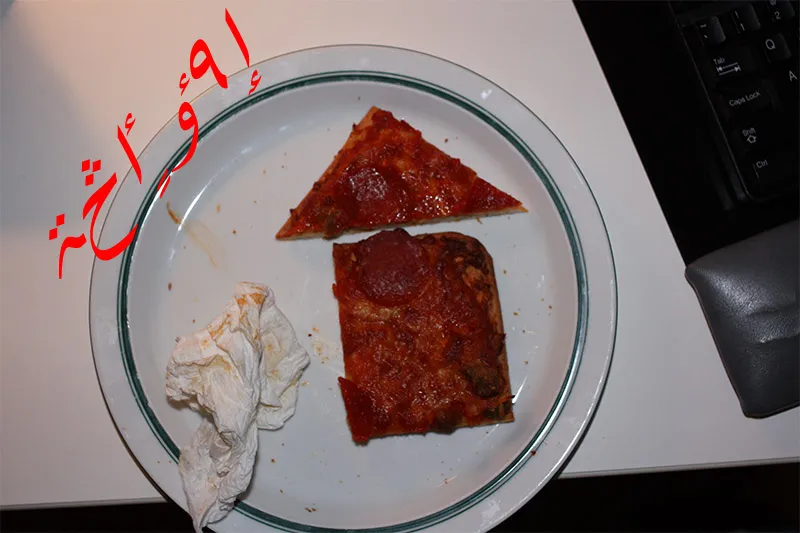
Photo: Dklone, CC0, via Wikimedia Commons
There’s a moment at every British pizza night when the box opens, the steam clears, and someone reaches for the cutter. That’s when the argument starts. Not about toppings. Not about the price. About the angle.
Six slices or eight? Twelve because there are kids? Squares because someone’s uncle once went to Detroit? The wedge is the most political object on the table. And in Britain, the unspoken default — the one nobody voted for but everybody enforces — is 45 degrees.
The default nobody voted for
A 45-degree wedge is what you get when you cut a round pizza into eight equal slices. It’s the Goldilocks cut: wide enough at the crust to hold, narrow enough at the tip not to flop, and consistent enough that everyone gets the same deal. Ask for “eight slices” in a takeaway and you’ll get a nod. Ask for six and you’ll get a look.
“Eight is just what people expect,” says Marta, who runs a by-the-slice counter in Sheffield. “If I cut a twelve-inch into six, someone will say it’s a wedge of cake. If I cut it into twelve, someone will say I’m charging for air. Eight is the peace treaty.”
A wedge is a load-bearing structure
Geometry matters more than most eaters admit. A 12-inch pizza has a radius of six inches. Cut it into eight, and the crust edge of each slice is roughly 4.7 inches long. Cut it into six, and that edge stretches to about 6.3 inches — a floppy, handle-heavy slice that demands two hands and a forward lean. Cut it into twelve and the crust edge shrinks to roughly 3.1 inches, which is fine for a party, less fine if you’re hungry and standing up.
The 45-degree slice also distributes toppings predictably. Every bite gets a similar run from tip to crust. A 60-degree slice gives you a wide crust end and a narrow point, so the first bite is mostly sauce and the last is mostly dough. A 30-degree slice is a sliver — elegant, impractical, and gone before you’ve found a napkin.
Callum, a home baker in Glasgow who has strong views about his domestic oven, cuts eight “because the maths is done for you”. He says: “Forty-five degrees is the only angle that gives you a crust handle and a tip that doesn’t collapse. I’ve tried six. It’s a plate-sized mess. I’ve tried twelve. It’s canapés for people who hate joy.”
Six is generous, twelve is a negotiation
None of this is to say six or twelve are wrong. Six is the cut of generosity: bigger slices, fewer decisions, more chance of a second round. It works for a 14-inch pizza or a hungry table of three. Twelve is the cut of diplomacy: a birthday party, an office lunch, a family where one cousin doesn’t eat cheese and another won’t touch basil. Twelve lets everyone take a bit without committing.
Priya, who manages a takeaway in Leicester, says the request changes with the weather. “Friday night, it’s eight. Big match, it’s twelve. Someone’s nan is over, it’s six because she wants a proper piece. You learn the codes.”
The voices at the counter
At a slice shop in Leeds, the default is six for a 16-inch pie and eight for a 12-inch. “By-the-slice is different,” the owner says. “You want a slice that looks generous on the tray. Six looks generous. Eight looks mean if the pizza is big. But if you’re selling a whole pie to take home, eight is what people want. It’s a psychological thing.”
A home baker in Bristol disagrees with all of it. “I cut eight, but I don’t measure. I cut to the clock: twelve, three, six, nine, then halve each quarter. That’s forty-five degrees. It’s not a rule, it’s just the easiest way to make it look like you know what you’re doing.”
That’s the thing about the 45-degree rule. It isn’t law. It’s a habit that became a standard because it solves three problems at once: structural integrity, fair shares, and the need to stop arguing and eat.
Our hand-drawn angle guide
We drew this on the back of a takeaway menu, which is the correct format for all serious pizza research. It won’t survive a maths exam, but it will survive a dinner party.
| Cut | Angle at the tip | What it’s for |
|---|---|---|
| 6 slices | 60° | Big appetites, 14-inch pies, a table of three |
| 8 slices | 45° | The default. The peace treaty. The British way |
| 12 slices | 30° | Parties, kids, offices, people who say “just a sliver” |
If you cut a 12-inch pizza into six and don’t warn anyone, you’re not hosting. You’re ambushing. If you cut it into twelve and serve it on a plate with a fork, you’re running a tasting menu. If you cut it into eight, you’re probably about to have a normal Friday night.
The etiquette bit
The angle argument is rarely about geometry. It’s about fairness. A 45-degree wedge says: everyone gets the same. A 60-degree wedge says: I’m hungry and I’m in charge. A 30-degree wedge says: we’re sharing, but only just.
So the next time someone reaches for the cutter and asks “six or eight?”, answer carefully. You’re not just choosing a number. You’re choosing a shape, a portion, and a small piece of British pizza culture. At Pizza 45, we’d argue that a site named after an angle was always going to end up here. But we’d also accept a second slice, cut neatly, at 45 degrees.