What the Crust Can Prove: A UK Pizza Menu Claim Audit
Pizza menus have become a branch of advertising. A margherita is rarely just a margherita; it is hand-stretched, stone-baked, slow-fermented and 'artisan'. Some of those words tell you something useful about the crust. Others are there to make a £14 pizza feel like a bargain. At Pizza 45 we spend a lot of time looking at crusts, so we decided to put the language under the lamp. Not to score cheap points against independent shops — most of them are doing good work — but to work out which claims are worth listening to when you are hungry and standing in a queue.
In 2026, the UK pizza menu is more crowded than ever. Delivery-only brands, wood-fired vans, sourdough startups and pub kitchens all borrow the same vocabulary. The problem is that most of it is unregulated. 'Artisan' has no legal definition. 'Stone-baked' can mean a pizza baked directly on a stone deck, or a base par-baked somewhere else and finished in a tray. 'Hand-stretched' might mean the dough was shaped by a person, or that a machine did the hard work and a pair of hands gave it a final nudge. None of that is automatically bad. But if you are paying for a claim, it is fair to ask what it is doing on your plate.
The claims I tested
Over the past month I spoke to three independent pizzaioli — in Leeds, Bristol and Glasgow — and ordered margheritas from six UK places that lean heavily on menu language. I was not trying to crown the best pizza in Britain. I was looking for evidence: underside colour, crumb structure, how the base behaved when folded, whether it went leathery as it cooled, and how it reheated the next day. A good crust should survive all four.
The results were not a simple story of honest independents versus cynical chains. Some small shops used vague words because they did not know how to describe what they do. Some bigger operators used precise-sounding terms because their marketing team liked them. And a couple of places with the shortest, plainest menus made the most convincing dough.
What sourdough usually means — and what it should mean
Sourdough is the most abused term on the list. Properly, it means a dough leavened with a wild yeast starter rather than commercial yeast. That should give you a more open crumb, a slightly tangy aroma and a base that browns well without turning biscuity. In the test, the places that genuinely used a long-fermented starter produced crusts with blisters, a good chew and a clean, wheaty finish. One pizza labelled 'sourdough' had a tight, bready crumb and a flat flavour that suggested the starter was more of a seasoning than a leavening agent.
As one Leeds pizzaiolo put it: 'Sourdough is not a flavour you add at the end. It is a process. If it has not had time, it will not have the structure.' That is the useful test. Ask how long the dough has fermented. If the answer is vague, the word on the menu probably is too.
Stone-baked: a clue, not a guarantee
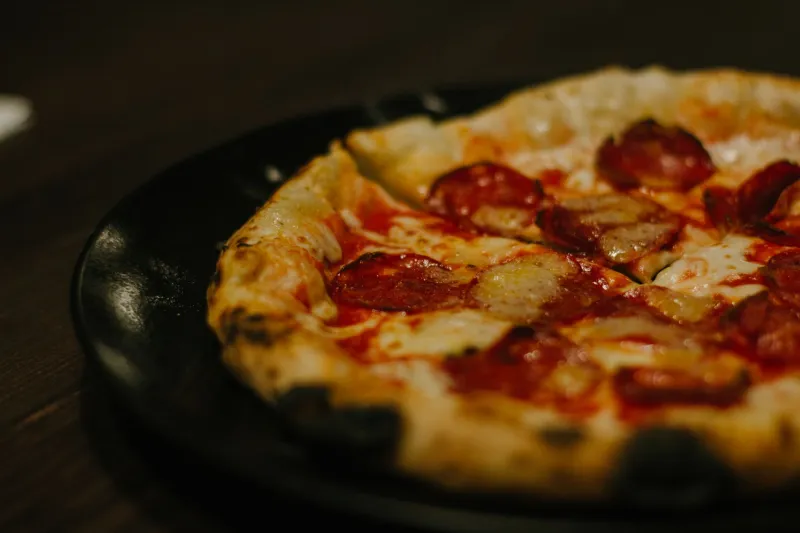
Stone-baked is a useful signal if it means what most people think it means: dough baked on a hot stone surface, usually in a deck oven. That direct contact gives a better base colour and a crisper underside than a pizza cooked on a tray. In the test, the stone-baked claims were broadly believable — the bases had more colour and a drier bottom — but the takeaway box undid a lot of the advantage. Ten minutes of steam in a closed box can turn a decent stone-baked base into something soft and defeated.
One Bristol pizzaiolo told me he has stopped using the phrase altogether. 'Everyone says stone-baked now. It does not tell the customer anything unless they know what oven you have and how you finish it.' He has a point. Stone-baked is a clue, not a guarantee. If the pizza arrives limp, the stone did not get the final word.
Hand-stretched and Neapolitan-style
Hand-stretched is hard to verify from the crust alone. An irregular shape is not proof of anything; a machine can make an irregular shape, and a rushed pair of hands can make a very regular one. What matters is whether the dough has been allowed to relax enough to stretch without tearing. In the test, the best hand-stretched pizzas had a puffy rim with a little tension and a thin centre that did not collapse under the toppings. The worst were uneven in a different way: thick in patches, greasy in the middle and pale at the edge.
Neapolitan-style is similarly slippery. It should suggest a soft, blistered crust, a wet centre and a quick, hot bake. In the UK, it often means a pizza with a puffy rim and a load of toppings that would make a Naples pizzaiolo wince. If the base cannot fold without cracking, or the middle is a swamp, the style is doing more work on the menu than in the oven.
The glossary you can actually use
Fresh dough. Ideally means dough made on site, not bought in frozen. It does not guarantee a long ferment. Ask when it was mixed.
Sourdough. Should mean a wild yeast starter. Look for blisters, an open crumb and a gentle tang. If it tastes like white bread with a sour note, be sceptical.
Stone-baked. Usually means baked on a stone deck. Look for good underside colour and a dry base. If the box has steamed it soft, you will never know.
Hand-stretched. A signal that the dough was shaped by a person. Look for a relaxed, even stretch rather than a perfectly round disc.
Neapolitan-style. Suggests a soft, blistered crust and a quick hot bake. It is a style, not a certification. Judge the fold, not the font.
Artisan. No legal meaning. It tells you something about the branding, not the crust.
Cold-fermented. A more reliable phrase than most. Long, cold fermentation usually gives better flavour and a more digestible crust. Ask for hours, not adjectives.
Wood-fired. Should mean a wood oven, which can give great char and fast baking. It does not guarantee good dough. A bad dough in a wood oven is still a bad dough.
How to order with more confidence
The short version: ignore the adjectives and ask two questions. How long has the dough fermented? What is it baked on? A good pizzaiolo will not mind. A vague answer is not proof of a bad pizza, but it is useful information.
Then look at the crust when it arrives. Is the underside coloured and dry, or pale and sweaty? Does the rim have some chew, or does it collapse into powder? Does the base fold without snapping? Those are the claims that actually show up on the plate. The menu can call it artisan. The crust has to prove it.