Cutting Remarks: A Field Guide to Britain's Pizza-Slicing Argument
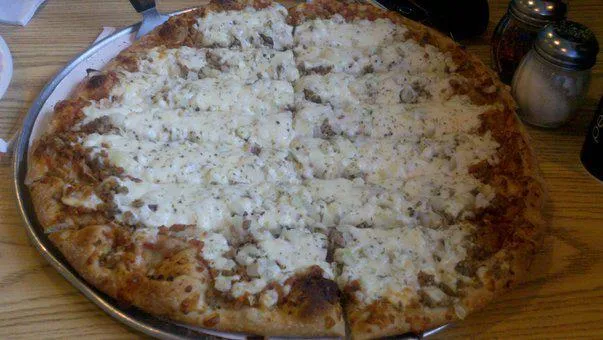
Photo: Ericnotderek, CC BY-SA 3.0, via Wikimedia Commons
There's a moment, about ninety seconds after a pizza hits the table, when a British household quietly splits into factions. Someone reaches for the wheel. Someone else says "just do squares". A third person — usually the one who's been to Rome — asks, mildly, whether we've considered scissors.
We have scissors. We always have scissors. The question is whether we're bold enough to use them on a Friday-night margherita with the football on in the background.
Cutting looks like the least interesting thing you can do to a pizza. It isn't. The cut decides who gets crust, whose slice goes floppy, how quickly the whole thing cools, and whether the last piece is a prize or a punishment. It's the cheapest variable in the entire pizza chain, and almost nobody thinks about it.
I spent a fortnight cutting pies every which way, pestering pizzaioli, and eating an unreasonable quantity of cold leftovers. Here's what the geometry says.
The wedge: gorgeous shape, structural flaw
The eight-wedge is the British default because it's what the box lid shows and what the word "slice" means in this country. It is also, from an engineering standpoint, a bit of a mess.
Take a 12-inch pizza. The circumference is roughly 94cm, so eight wedges hand each person about 11.8cm of crust — decent, but every slice narrows to a point that droops the second it leaves the board. You end up doing the walk of shame from kitchen to sofa with a limp triangle, cheese sliding, thumb burning.
Then there's what I've started calling the crust tax. A wedge is widest at the rim, so your first bite is almost all cornicione and your last is molten middle. For anyone who eats pizza for balance, that's the wrong way round.
Drop to six cuts and something interesting happens: crust per slice rises to around 15.7cm, the slices are narrower and easier to handle, and the tip droops less because there's less mass hanging off the end. Six is the geometry most people actually want and almost nobody asks for.
Squares: the party cut earns its keep
The tavern cut — a round pizza scored into a grid — still reads as "children's birthday" in Britain, which does it a disservice. Those crustless middle squares are the best bites on the entire pie: all topping, no rim, ideal for dipping. The corners, meanwhile, are almost pure crust, and who claims them tells you a lot about a person.
Where squares fall down is heat and fairness. More exposed edges means faster cooling, and a grid on a round pizza generates a load of awkward edge shards that nobody negotiates for. It's a board food, not a plate food. Serve squares on plates and you'll be mopping up with a fork within four minutes.
Strips and the Roman approach
Cut a tray pizza into long strips and you've essentially built a sandwich. That's the al taglio logic, and it's why the format travels so well — the strip has a constant topping-to-crust ratio from one end to the other, and it folds without cracking. The catch is hydration: strips only work when the dough can hold itself up. Try the same cut on a soft, wet Neapolitan and you get ribbons.
Scissors, and the quiet British conversion
Scissors are what people arrive at when they've stopped worrying about looking tidy. "A wheel is a press," one pizzaiolo told me, and he's right — you're bearing down on the only part of the pizza that spent two days trying to inflate. Every roll of the blade compresses the rim and welds the air pockets shut.
Scissors snip without squeezing. They work on wet dough, on hot dough, on a tray you can't lift out of the tin. They also let you cut one slice at a time, which matters if — like most households — you're not eating the whole thing in one go. Cut as you go. Keep the rest whole and it stays hot.
What I actually put to the test
Three pies, one Saturday. A 12-inch cold-fermented Neapolitan from a home oven with a stone; a 16-inch takeaway New York; a focaccia-style tray bake.
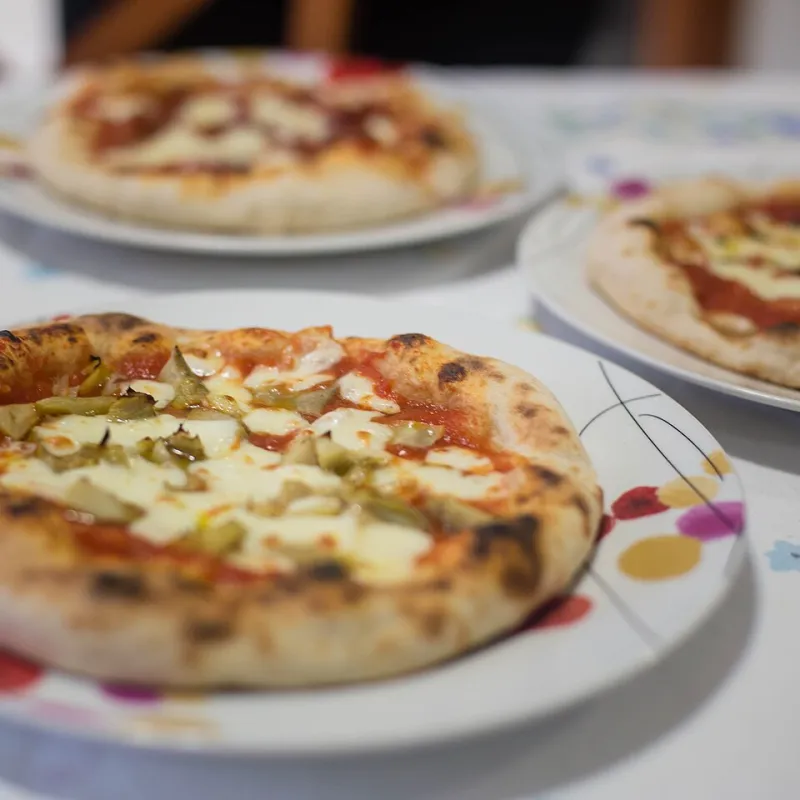
The Neapolitan got the wedge treatment first and drooped exactly as predicted — the point folded at the halfway mark, and the middle slices went limp within two minutes. Re-cut with scissors, same pizza, it behaved like something you'd actually paid for.
The 16-inch was cut into squares at the table. The centre four were sublime. The corners started a small argument.
The tray went into strips. Nothing to report, because nothing went wrong. That's the highest praise geometry gets.
The tilt matters as much as the cut
One trick that genuinely changed my eating: hold the slice and tip it roughly 45 degrees, point towards the middle of the pizza, before you take the first bite. Gravity pulls the cheese back onto the slice instead of into your lap, and any pooling oil runs away from the tip.
But you can only tilt a slice that has structure. That's the argument for cutting less aggressively and handling more carefully. A wide wedge can be tilted and folded. A square can't. A strip is halfway to folded already.
The default I'd defend
Six cuts on a 12-inch, eight on a 16-inch, scissors for anything above 65% hydration, squares only when there are five or more people and at least one of them is under ten.
And one rule that beats all the others: don't cut what you're not about to eat. A whole pizza stays hot. A cut pizza starts dying. Cut, eat, repeat — and keep the wheel in the drawer where it belongs.