Eighteen People, One Box: Running a UK Office Pizza Order Without a Putsch
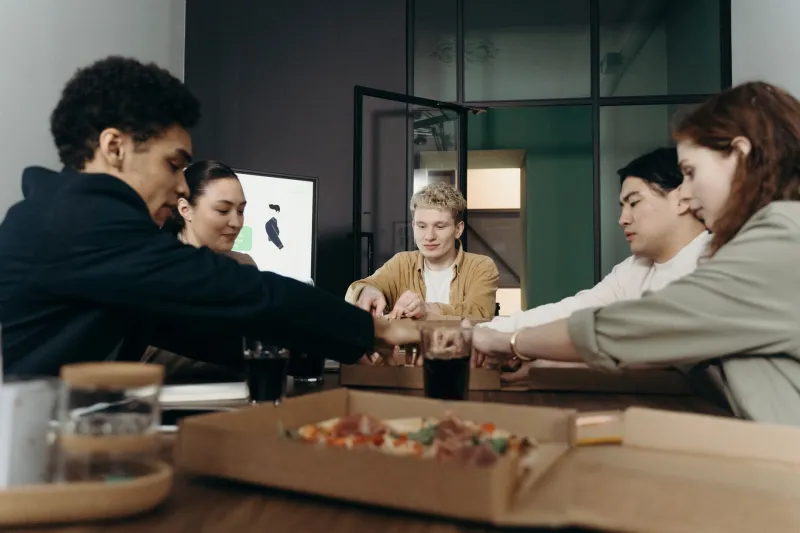
At 12:41 on a Tuesday, someone in the office group chat types the most dangerous sentence in British working life: 'Pizza for lunch?' Within four minutes, eighteen people have opinions, two people have gone quiet, and one person has said 'anything's fine' in a tone that suggests the opposite. By 13:20, the food has arrived, the margherita has vanished, and somebody is eating a gluten-free base they did not ask for while staring into the middle distance.
The office pizza order is not really about pizza. It is a small, greasy exercise in governance. Get it right and everyone likes each other a bit more by 14:00. Get it wrong and you will hear about the anchovies until the next bank holiday.
The problem is not hunger; it is committee design
A group order fails for predictable reasons. People have different budgets. People have dietary needs that are private until they are urgent. People have strong feelings about crust, pineapple, and whether a garlic dip counts as a vegetable. And because nobody wants to be the person who makes lunch complicated, the complicated information arrives late, usually after the order has been placed.
Pizza 45 is not against debate. We are against a debate that ends with a cold box and a passive-aggressive note in the kitchen. So we treated the office order like a proper slice verdict: three strategies, one lunchtime, and a clear ruling at the end.
Strategy one: the open group chat
This is the default. Someone asks who wants pizza, a link is dropped, and everyone is invited to build their own ideal order in public. On paper, it is democratic. In practice, it is a 63-message thread with three competing polls, one person lobbying for a stuffed crust, and a late joiner asking whether the order has already gone in.
What works
It surfaces enthusiasm. People who never speak in meetings will suddenly have a lot to say about hot honey. It also gives the organiser a rough headcount without chasing anyone individually.
What fails
The open chat rewards the loudest voice and punishes the person with a serious allergy, who now has to disclose it to eighteen colleagues to avoid being handed the wrong slice. The 'anything's fine' colleague is no help at all, because they will accept anything and then look quietly disappointed when the vegan option is a bowl of rocket. And the deadline is never real. There is always one person who replies after the order is placed and asks if they can 'just add one'.
Verdict: charming, chaotic, and too slow for a working lunch. Use it for a Friday treat if you have no dietary landmines and no fixed time. Do not use it for a team of eighteen.
Strategy two: the spreadsheet and the hard cut-off
Here, one organiser takes control. A simple grid goes round: name, pizza choice, dietary notes, money. The cut-off is 11:45. No exceptions. It feels a bit like booking a meeting room, but it works.
The spreadsheet is excellent at one thing the group chat cannot manage: a real deadline. It also gives the organiser a clear picture of what to order and who owes what. The downside is that it can turn into a small tyranny. If the organiser picks the menu alone, the group has no real choice. If the organiser leaves the grid too open, you get twelve completely different pizzas, which means twelve boxes, twelve sets of slices, and a delivery bill that makes everyone wince.
Verdict: efficient, fair, and slightly soulless. It is a strong option for a regular team lunch where everyone knows the drill. It works best with a short menu and a fixed price per head, not a free-for-all.
Strategy three: the fixed-menu committee
This is the one we would actually recommend. The organiser does not ask 'what does everyone want?' They ask a narrower question: 'We are ordering six large pizzas for twelve people. Any dietary needs before 11:30?' Then they build a menu that covers the room without turning lunch into a ballot.
A sensible fixed menu is not boring. It is a peace treaty. Two margheritas, two pepperoni, one vegetarian, one vegan, plus a couple of sides and a pot of garlic dip. If the group is bigger, scale up the safe options first and add one wildcard — a hot honey number, a mushroom and truffle oil situation, whatever feels like a treat. The wildcard is there for the people who care. The safe pies are there for everyone who just wants a slice.
The private dietary check is non-negotiable
This is the bit most offices get wrong. Allergies are not preferences. Coeliac disease is not a lifestyle choice. Halal and vegan needs are not an inconvenience. Ask privately, not in the main chat, and make sure the final order is labelled clearly when it arrives. If someone needs a gluten-free base, order it as a separate item and keep it away from the shared boxes. If the vegan pizza is the only vegan thing on the table, do not let the pepperoni eater 'just try a slice' while hovering over the box.
Verdict: this is the committee pie done properly. It is not a pure democracy. It is a benign pizza monarchy with a written constitution, and it keeps the lunch moving.
The crust politics
Crust is where office orders get personal. Thin and crispy is the safe default for a group because it travels well and does not sit like a brick. A deep-pan or stuffed crust is a strong move for morale but a weak move for variety, so order one at most. And keep dips on the side. A garlic dip is a condiment, not a topping, and the person who pours it over the whole box should be given a quiet word and a napkin.
The money question
If the company is paying, set a cap and stick to it. If everyone is paying, choose one of two systems: a fixed price per head, or an itemised order where sides are shared. Do not mix the two halfway through and hope for the best. Resentment about a £3 shortfall lasts longer than the pizza.
The Pizza 45 verdict
The office pizza order should not be an open forum. It should be a short, well-run operation with one organiser, a hard deadline, a narrow menu, a private dietary check, and labels on every box. The group chat can have the banter. The spreadsheet can have the names. The fixed menu does the actual work.
Keep the slices coming, keep the options simple, and keep the peace. That is a lunch worth ordering.